
Plywood Worktop: Properties, Uses and Impregnation
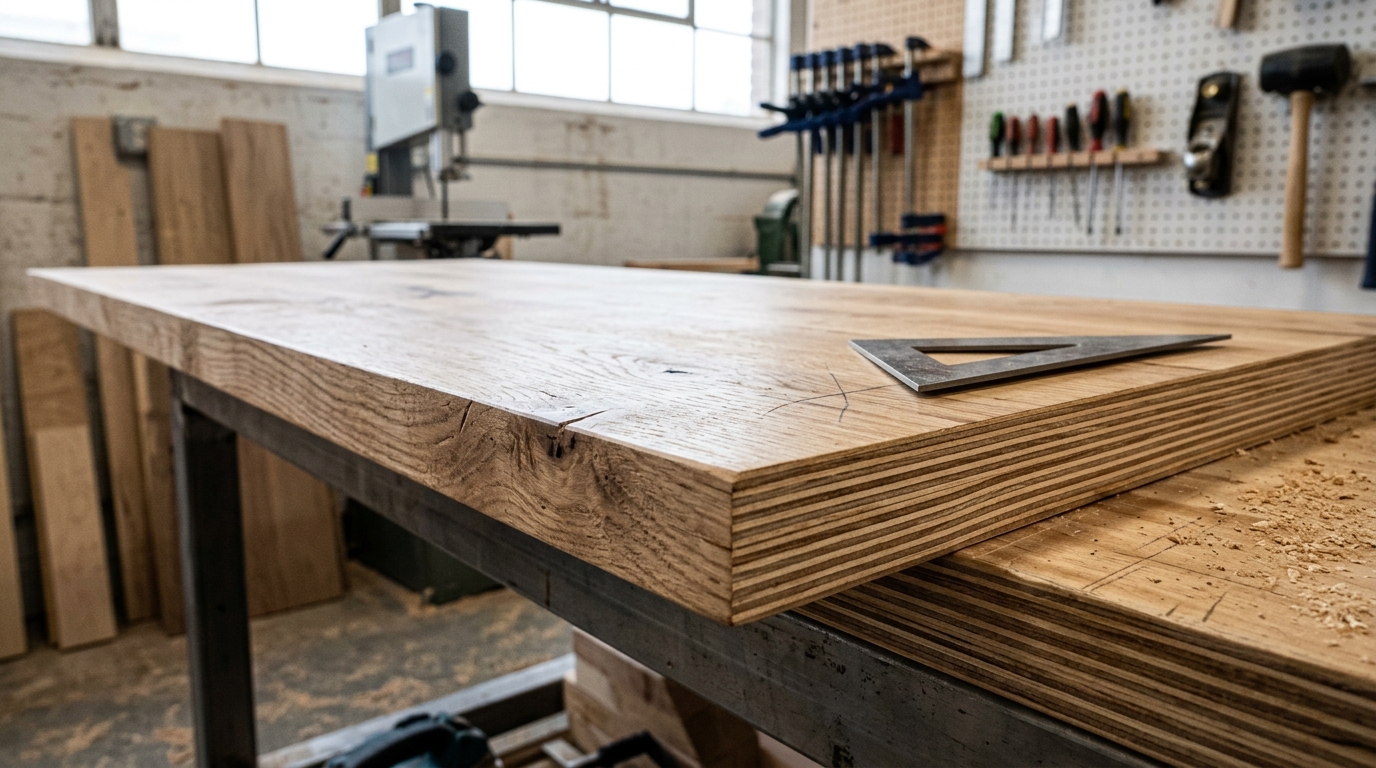
A plywood worktop is a solution increasingly chosen not only for workshops, but also for kitchens, garages and utility rooms. Plywood combines strength, versatility of use and an affordable price, which makes it an attractive alternative to traditional materials.
What Is Plywood and Why Is It Suitable for a Worktop?
Plywood is a construction material made up of many thin layers of wood (veneers) bonded together under high pressure. The layers are laid crosswise, which gives plywood exceptional dimensional stability and resistance to deformation.
The main advantages of plywood as a worktop material are:
- Mechanical strength – plywood withstands heavy point loads and evenly distributed loads
- Dimensional stability – it does not move as much as solid wood
- Resistance to cracking – the multi-layer structure minimises the risk of damage
- Workability – it is easy to cut, drill and rout
- Cost-effectiveness – a lower price than solid wood or some composites
Types of Plywood Used for Work Surfaces
Structural Plywood
Structural plywood is the most popular variety used in workshops and technical rooms. Made from birch or pine veneers, it offers good load capacity and resistance to mechanical damage. It is available in thicknesses from 12 mm up to 50 mm, which allows it to be matched to specific requirements.
Film-Faced Shuttering Plywood
Film-faced shuttering plywood is covered with a phenolic layer, which increases its resistance to moisture. Although originally intended for construction use, it also works very well as a work surface where there is a risk of contact with water or other liquids. Its surface is smooth and easy to keep clean.
Waterproof Plywood
Phenolic or melamine glues are used to bond the layers, giving high resistance to moisture. This type of plywood is ideal for workshops where cooling fluids, oils and other substances are often used.
Plywood Worktop Thickness: How to Choose the Right One
The choice of plywood thickness depends on the expected load and the application:
- 18-21 mm – light applications, shelves, auxiliary worktops
- 24-27 mm – standard work surfaces, workshop assembly tables
- 30-40 mm – heavy workshop applications, stations with large loads
- 45-50 mm – professional production stations, extreme loads
Thicker worktops provide better stability and can be sanded repeatedly if the surface is damaged, which significantly extends the life of the worktop.
Impregnation and Protection of a Plywood Worktop
Unprotected plywood is prone to moisture, stains and mechanical damage. Proper impregnation is the key to long-lasting use.
Wood Oils
Natural oils (linseed, tung) penetrate deep into the wood structure, bringing out its natural texture. They need renewing regularly (every 6-12 months), but they give a surface that is pleasant to the touch and make local damage easy to repair.
Varnishes
Polyurethane or water-based varnishes form a durable, sealed coating on the surface of the plywood. They are more resistant to abrasion and stains than oils, although they require careful surface preparation before application. Two-component varnishes offer the highest chemical and mechanical resistance.
Wax
Waxing can be used as a complement to oiling. Natural wax gives an additional protective layer and makes the surface easier to clean.
Epoxy Resins
An epoxy coating gives the highest protection against moisture, chemicals and mechanical damage. It is particularly recommended in industrial environments or car workshops, where contact with aggressive substances is unavoidable.
Fitting a Plywood Worktop
When fitting a plywood worktop, pay attention to several key points:
- Support – the plywood should be supported every 60-80 cm to avoid sagging
- Fixing – it is recommended to fix it from underneath using brackets or battens, avoiding drilling through the work surface
- Edge protection – the edges of plywood are the most vulnerable to damage and moisture ingress, so it is worth impregnating them with particular care or covering them with edging
- Expansion gap – leave 2-3 mm of play at walls for the natural movement of the material
Maintenance and Upkeep of a Plywood Worktop
Proper maintenance significantly extends the life of the worktop:
- Clean regularly with a damp cloth, avoiding excess water
- Remove spilled liquids immediately
- Renew the protective layer (oil, wax) periodically
- Avoid direct contact with very hot objects
- Sand and re-impregnate if there is deeper scratching
Disadvantages and Limitations of Plywood as a Worktop Material
Despite its many advantages, plywood also has some limitations:
- It needs regular maintenance and renewal of the protective layer
- Unprotected, it is prone to moisture and swelling
- It can discolour under UV light
- The edges are prone to chipping if machined incorrectly
- Quality can vary considerably depending on the manufacturer
Alternatives to Plywood
Depending on your specific requirements, it is also worth considering other materials. Solid wood offers a beautiful look and can be renovated many times, although it is more expensive and more prone to deformation. HPL laminate boards provide excellent chemical resistance and need no additional impregnation, but are harder to machine. Steel worktops offer the highest durability in harsh industrial conditions, but are much heavier and more expensive.
Summary
A plywood worktop is a practical and cost-effective solution that, with proper impregnation and maintenance, serves for many years. Its versatility, ease of machining and good strength make it suitable for professional workshops and home workrooms alike. The keys to success are choosing the right thickness, careful impregnation and regular maintenance, which will protect the material from moisture and mechanical damage.